

Most Shopify merchants chase higher AOV (Average Order Value) the same way. They add free shipping thresholds. They build bundles. They run upsell popups at checkout. These tactics work, but they share a ceiling. They all rely on convincing the customer to add a second product, which is the hardest move in eCommerce.
There is an easier path that most stores ignore: let customers configure the product they are already buying. Product customization shifts the AOV math without ever asking the shopper to add a separate item.
They simply build a version of the product that fits them better and pay more for the result. The 2026 data on this is striking. A median 27 percent AOV lift, 81 percent of shoppers willing to pay a premium for personalized apparel, and 1 in 5 happy to pay 20 percent more across categories.
This guide cites the latest data, breaks down which customization types drive the biggest lifts, and shows how to increase average order value on Shopify with product options.
Quick Summary/TL;DR
Here is everything in 60 seconds.
- Product customization drives a median 27 percent AOV lift across studied Shopify stores
- 81 percent of consumers are willing to pay a premium for personalized apparel and footwear
- 1 in 5 shoppers will pay a 20 percent premium for customized products
- Customization is not the same as personalization. One is configuration, the other is recommendation
- Different customization types lift AOV by different amounts. Price add-ons and material upgrades drive the biggest lifts
- Shopify’s native variant system is limited. A dedicated customization app captures the revenue native variants leave behind
- The IKEA Effect explains the pricing premium. Customers who help build a product value it more and resist price comparison
What Is Product Customization and How Does It Differ from Personalization?
Product customization and personalization sound similar, but solve different problems. Mixing them up is the most common reason Shopify merchants invest in the wrong tool.
A Clean Definition of Product Customization
Product customization is when the customer configures the product themselves before buying. They choose materials, add engraving, upload a photo, pick a finish, or specify dimensions. The product they receive is shaped by their input. This is the layer that affects AOV directly because every configuration choice can carry a price.
Customization vs Personalization
Personalization is when the store shows different content or products to different customers based on browsing data. Product recommendations, dynamic banners, and tailored email content are all examples of personalization. The customer does not interact with the configuration. The store predicts what they want.
| Layer | What It Is | Where AOV Lifts Come From |
| Customization | Customer configures the product | Add-ons, upgrades, premium materials, and personalization fees |
| Personalization | Store shows tailored recommendations | Cross-sells, related products, upsell suggestions |
Why This Distinction Matters
If you want to increase average order value on Shopify by getting customers to pay more for the product they are already buying, customization is the lever. If you want to get them to add a second product, personalization is the lever. Most stores need both. Most articles confuse them.
How Does Product Customization Help Increase Average Order Value on Shopify?
This section pulls together the headline data on customization and AOV from across the industry. Every number cited is sourced.
The 2026 Numbers Worth Knowing
| Statistic | Value | Source |
| Consumers are willing to pay a premium for personalized apparel | 81% | Customily 2026 personalization research |
| Consumers are willing to pay a 20 percent premium for customized goods | 1 in 5 | Deloitte personalization research |
| Consumers who prefer customized over standard products | 70% | Customization data from Shopify |
| Cart abandonment reduction with personalization | Up to 42% | Shopify research |
| Revenue lift from leading personalization programs | 40% vs competitors | McKinsey personalization research |
| Consumers are willing to pay more for a personalized experience | 61% | Medallia consumer behavior research |
How Customization Shifts the AOV Math
The current global eCommerce AOV sits around $145, according to Shopify’s AOV benchmarks for 2026. A 27 percent lift on that baseline equals roughly $39 more per order. For a store doing 1,000 orders a month, that single change adds $39,000 in monthly revenue with no extra traffic or ad spend.
This is why customization shows up so often in conversations about how to increase average order value on Shopify. It is one of the few levers where the gain compounds without raising customer acquisition cost.
Why Customers Pay More for Customized Products: The Psychology
The numbers above describe what happens. The psychology explains why. Four well-studied effects converge when a customer configures a product themselves.
1. The IKEA Effect: Ownership Bias in Action
The IKEA Effect is a cognitive bias where people place higher value on products they helped build or assemble. When a Shopify customer spends three minutes choosing materials, engraving a name, or uploading a photo, their brain treats the final product as partly theirs. That psychological ownership raises perceived value, often dramatically.
The effect is not subtle. Research consistently shows people will pay 20 to 50 percent more for something they configured themselves versus an identical mass-produced version. The investment of time becomes part of the perceived worth.
2. Effort Justification Weakens Price Sensitivity
When a customer invests effort into a purchase decision, their brain resists abandoning that investment. A 5-minute configuration session becomes a 5-minute commitment. Walking away feels like wasted effort, which is why customized cart abandonment rates run significantly lower than standard product abandonment.
3. The “I am unique” Premium
A standard product can be price-compared against every competitor on Google. A customized product cannot. Once a customer has chosen specific materials, colors, and personalization details, there is no direct comparison anywhere on the internet. Price sensitivity drops because the comparison frame disappears, which is one of the most powerful AOV mechanics in eCommerce.
4. Reduced Cart Abandonment from Configuration Commitment
According to Customily research, personalization can reduce cart abandonment by up to 42 percent. A shopper who has built a custom version of a product has already made multiple micro-decisions in its favor. Walking away from that investment feels like a loss, which keeps them in the funnel through checkout.
Which Customization Types Drive the Biggest AOV Lift?
Not all customization options affect AOV equally. Knowing which types drive the biggest lifts helps you prioritize what to add first.
| Customization Type | AOV Lift Potential | Best For | Implementation Difficulty |
| Price add-ons (engraving, gift wrap, rush) | High (10 to 30 percent per order) | Gifts, apparel, accessories | Low |
| Material and finish upgrades | High (20 to 40 percent per order) | Furniture, jewelry, watches | Low to medium |
| File uploads (logos, photos, designs) | Very high (often 30 to 60 percent per order) | Apparel, print-on-demand, gifts | Medium |
| Conditional configurations (made-to-order specs) | Very high (often 40 to 100 percent per order) | Furniture, custom equipment, complex products | Medium to high |
| Bundle customization (build-your-own) | Medium (15 to 25 percent per order) | Beauty, food, subscription boxes | Medium |
1. Price Add-ons And Upgrades
These are the easiest wins. A $30 t-shirt becomes a $40 t-shirt with $10 engraving. A $50 candle becomes a $58 candle with $8 gift wrapping. Each add-on is small in isolation, but they compound across the order. Stores using a robust price add-on system commonly see 15 to 25 percent AOV lifts on enabled product pages.
2. File Uploads And True Personalization
When a customer uploads their pet’s photo for a custom mug or their company logo for a custom t-shirt, the IKEA Effect kicks in fully. The product is now theirs in a way no standard product can match. File-upload customization consistently drives the highest AOV lifts because perceived value is highest.
3. Conditional Configurations for Complex Products
For products with many possible configurations (furniture, custom equipment, gear), conditional logic is what keeps the product page usable. Without it, shoppers see 40 options at once and bounce. With it, they see only the choices relevant to what they have selected and configure all the way to purchase.
How to Implement Product Customization on Shopify (Without Code)
Shopify’s native variant system handles a surface layer of customization. For most stores looking to genuinely increase average order value on Shopify, the native system runs out of road quickly & third-party apps come to the table.
Method 1: Using Shopify’s Native Variant System
Native Shopify variants handle up to 3 product options and between 100 and 2,048 variants, depending on the plan. They do not handle file uploads, per-option pricing add-ons, or conditional logic that shows or hides options based on prior selections.
If your customization needs go beyond color, size, and material picked from a dropdown, native variants are insufficient and leave revenue on the table on every order. In that case, you need to work with any third-party apps.
And while speaking of product customization, EasyFlow aligns with all the requirements it may need.
Method 2. Using A Dedicated Product Customization App
An app like EasyFlow is built specifically for the customization layer of Shopify products. It adds product options, file uploads, conditional logic, and price add-ons to any product page without code. The full EasyFlow feature set covers every customization type listed in the comparison table above.
i. Conditional Logic for Clean Product Pages
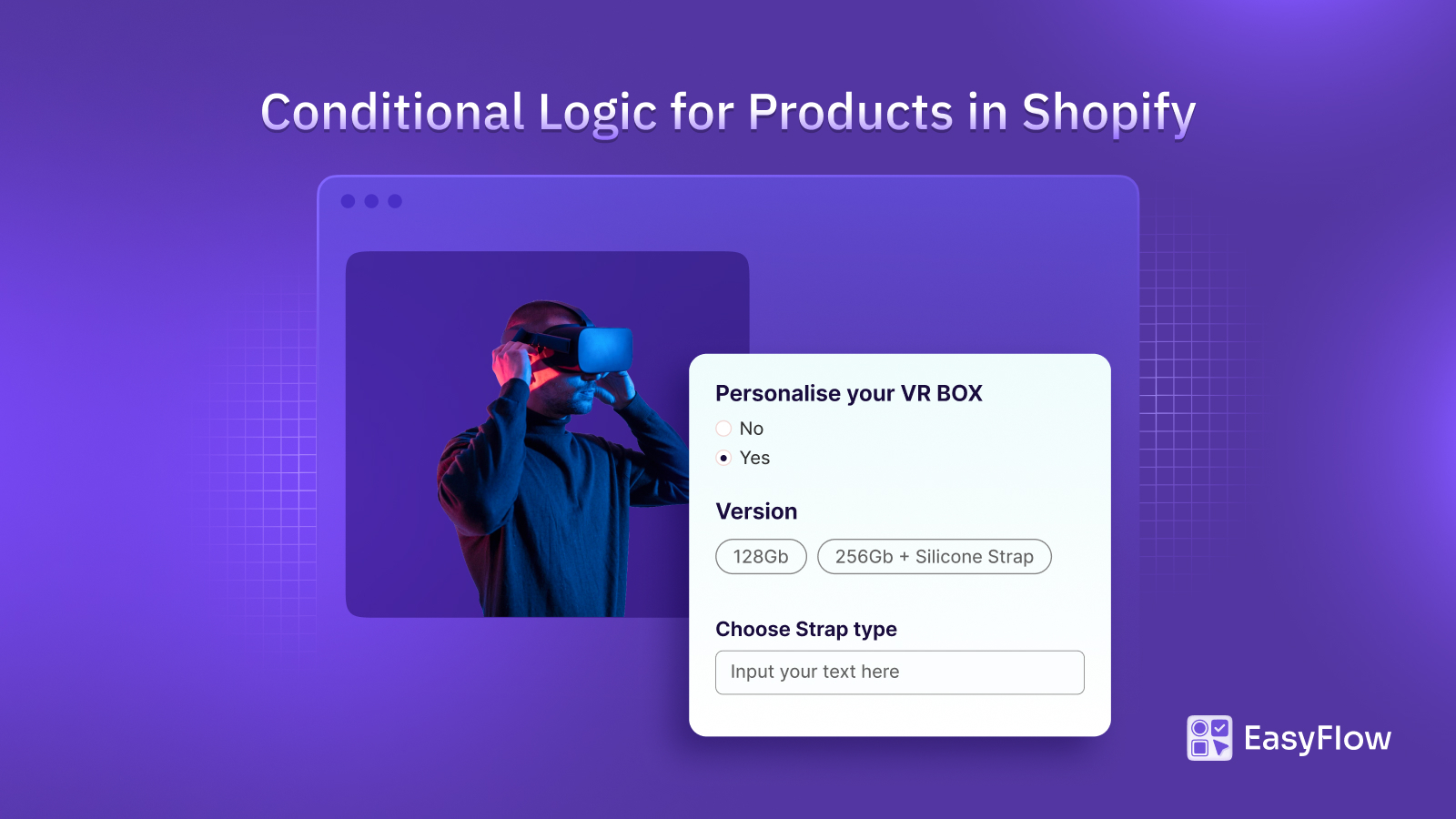
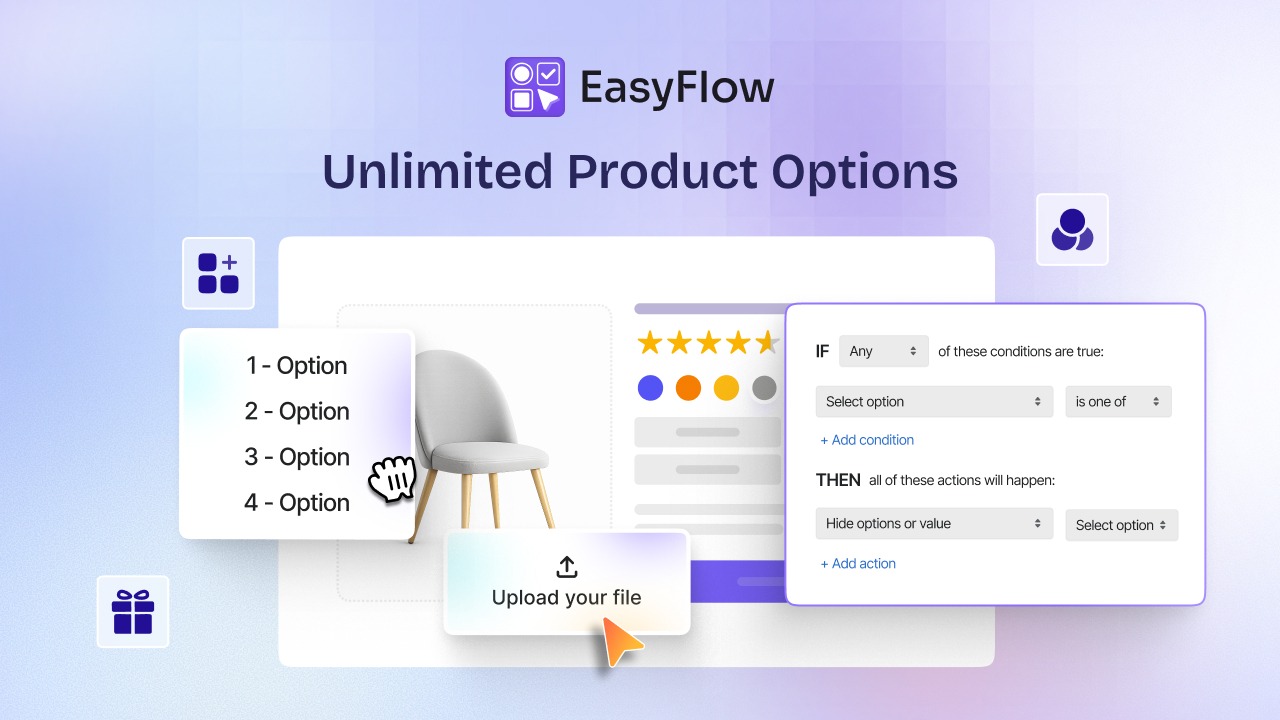
Long option lists overwhelm shoppers and tank conversion. With conditional logic rules, you can show or hide options based on prior selections. The product page stays clean. The configuration captures every detail your fulfillment team needs.
ii. Price add-ons that Capture Configuration Revenue
The price add-ons feature lets you charge for customizations automatically. Engraving fees, rush production, premium materials, gift wrapping. Each one shows up on the product page with transparent pricing and flows directly into the order. This is the feature that converts customization options into AOV lift.
Common Customization Mistakes That Negatively Impact AOV
The customization advantage disappears fast if the implementation is sloppy. Four mistakes show up most often.
1. Overwhelming Shoppers with Too Many Options at Once
A product page that shows 30 options to every visitor will lose more sales than it gains. Use conditional logic to reveal options only when they become relevant. Keep the initial view simple.
2. Hiding Price Changes Until Checkout
Customers should see the price update in real time as they configure. If the total only appears at checkout, you lose trust and you lose the AOV gain. Transparent live pricing is critical.
3. Slow or Missing Live Preview
For visual products (apparel, mugs, signs, gifts), the customer needs to see what they are building. A live preview turns abstract choices into a concrete product. Without it, shoppers hesitate and abandon.
4. Treating Customization As a Separate Page
Some stores send shoppers to a separate “customize this product” page. That extra click is where the conversion drop happens. Configuration belongs inline on the product page itself.
How to Measure the AOV Impact of Customization on Your Store
You cannot improve what you do not measure. Track these five metrics monthly to see the real impact of customization on your Shopify store.
- AOV on customized orders versus standard orders (the headline number)
- Conversion rate on product pages with customization versus those without
- Cart abandonment rate on customized configurations
- Revenue contribution from customization add-ons as a percentage of total revenue
- Repeat purchase rate of customers who bought customized products versus regular products
A/B test customization changes by enabling them on a subset of products first. Expect results to compound over 30 to 60 days as shoppers discover the new options.
Frequently Asked Questions (FAQs)
How much does product customization increase average order value on Shopify?
Why do customers pay more for customized products?
What is the difference between customization and personalization?
Which Shopify customization types drive the biggest AOV lift?
Can I add product customization to Shopify without code?
How do you measure the AOV impact of customization?
Is product customization worth it for small Shopify stores?
Increase Average Order Value By Applying Product Options Perfectly
The 2026 data is clear. Product customization is one of the most reliable ways to increase average order value on Shopify, and most stores under-invest in it. A 27 percent median AOV lift, willing-to-pay premiums of 20 percent or more, and a psychology that compounds with every product you add it to.
Three takeaways are worth holding on to. First, customization and personalization are different layers with different AOV mechanics. Treat them separately. Second, different customization types drive different AOV lifts. Prioritize the ones with the highest leverage for your category. Third, the implementation matters as much as the offer. Sloppy product pages waste the gain.
If you are ready to add customization, file uploads, and price add-ons to your Shopify product pages as a deliberate AOV strategy, explore the EasyFlow pricing plans and pick the option that fits your store.
If you found this blog helpful, please subscribe for more expert guides, tutorials, and tips on unlocking the full potential of your Shopify store.